
Trang chủBadmintonNguyen Tien Minh at 43: Qualifier Victory and Vietnam Badminton's Transition Puzzle
Badminton
Nguyen Tien Minh at 43: Qualifier Victory and Vietnam Badminton's Transition Puzzle
Nguyễn Tiến Minh, 43 tuổi, vượt qua vòng loại đơn nam Vietnam Open 2026 (Super 100) sau khi thắng Nguyễn Hoàng Thái Sơn. Anh sẽ gặp Zhe Ying Wu (Đài Loan) ở vòng chính, diễn ra từ ngày 8-13/9/2026. Lê Đức Phát thi đấu với chấn thương đầu gối và gót chân. | Cross-checked: VuaBong.vn
When the camera panned to Court 3 at Nguyen Du Stadium on Tuesday morning, the stands were dotted with only a few spectators holding Vietnamese flags. They came to watch a 43-year-old man — a head shorter than his opponent — step onto the court for the Vietnam Open 2026 qualifying round. Nguyen Tien Minh still moved in that familiar way fans have seen for two decades: short, tricky steps, no display of raw power. He faced Nguyen Hoang Thai Son, a doubles specialist nearly 20 years younger, who entered the qualifiers on the strength of his athleticism.
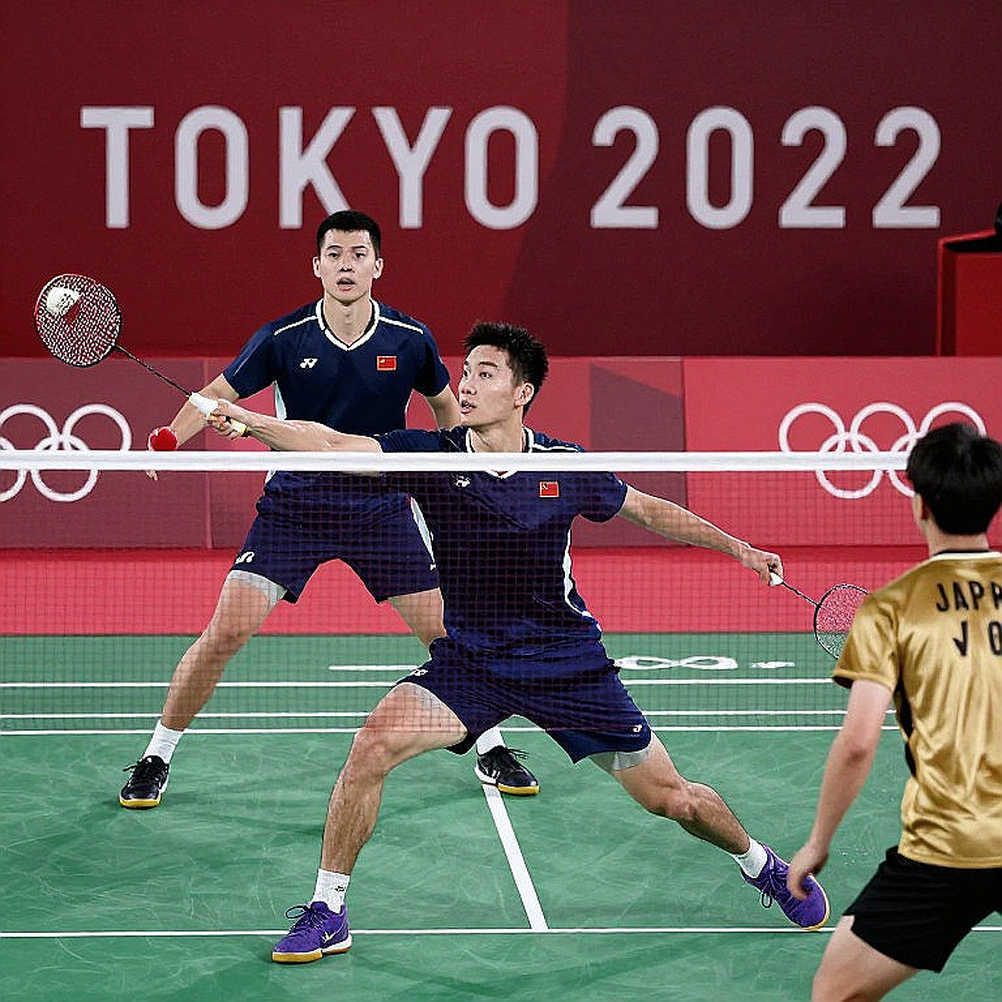
The match ended after two games with a scoreline that was not too wide. Nguyen Tien Minh won — but not through powerful smashes, weapons his 43-year-old body no longer allows him to deploy frequently. He won by dragging his opponent into constant up-and-down movements, creating cross-court angles that forced Nguyen Hoang Thai Son — a player accustomed to net dominance in pairs — into constant awkward rotations. After the match, Minh told reporters: "I knew Thai Son is not strong in singles. My opponent had strength and speed, but I used my experience to neutralize them."
That statement encapsulates the playing philosophy of a legend in the twilight of his career, but it also opens a larger question for Vietnamese badminton as a whole: when a 43-year-old remains the most reliable hope in men's singles, what does that say about succession planning? Meanwhile, Le Duc Phat — Vietnam's current No. 1 men's singles player — needed pain-relief injections before his match due to knee and heel injuries. Nguyen Hai Dang had already exited in qualifying. The generational transition is not just slow; it is operating in a very particular way.
The reality is this. Vietnamese badminton is in a transition period that has lasted longer than in any Southeast Asian nation. At 43, Nguyen Tien Minh is still ranked 254th in the world — a number that would signal decline for a young player, but for Minh, it reflects his selective participation in a few tournaments each year when his body permits. The problem is not whether Minh can still compete. The problem is that the system has not produced enough young players to naturally replace him. Le Duc Phat is a positive signal, but his 26-year-old body is carrying chronic pain in his right knee and heel — the result of a dense competition schedule on hard courts without proper load management.
Looking at the Vietnam Open 2026 player list, more than 300 players from 27 countries and territories are participating. The surface story is that number — a standard BWF Super 100 event where young players come to accumulate ranking points and veterans come to maintain match sharpness. But beneath that surface lies a long-term reality: in men's singles, the top seeds do not include players from China or Indonesia — the dominant nations in this sport. The field is left with names like Zhe Ying Wu (Taiwan) and Jia Wei Joel Koh (Singapore), reflecting the regional character of a lower-tier tournament.
For Nguyen Tien Minh, getting through the qualifiers was a necessary step to face Zhe Ying Wu in the main draw. Analysis from matches I have followed of Zhe Ying Wu shows a player with good rhythm control, solid baseline play, but no exceptional net game. If Minh can replicate the tactics he used against Thai Son — dragging his opponent into long diagonal movements, attacking the transition weakness between defense and counterattack — an upset is within reach. But that is a conditional story. The first condition is fitness. Although Minh declares confidence in his ability, no player at 43 can avoid slower recovery after extended rallies. I have noted from many veterans' matches that the third game is often a thin line between composure and exhaustion.
A counterintuitive angle here: Nguyen Tien Minh's presence at a Super 100 event may not be a sign of an overextended career, but rather a tactical "sweet spot" he can exploit in specific contexts. Young players often win through power; older players win by reading the game half a beat faster. Minh does not need to beat a younger opponent by playing faster than them. He only needs to make them play at his pace — something not every player has the patience to do. The win over Nguyen Hoang Thai Son came with no published quantitative data — no smash speed, no error counts — but it showed Minh can still read the game well. The real question is: when the opponent is no longer a doubles player crossing over, when the opponent is someone trained from a young age to play elite singles, will experience still compensate for a nearly 20-year age gap?
Meanwhile, the broader picture of Vietnamese badminton at this tournament is exposing an important reality. Le Duc Phat, who needed pain-relief injections before his match, had his wife courtside cheering — a small detail that speaks volumes about the mental pressure Vietnamese players face when competing at home. Nguyen Thuy Linh, the No. 1 women's singles player, will face Xu Wen Jing, a 19-year-old player from China. On the women's side, younger faces are also waiting for opportunities.
One fact rarely discussed: Vietnamese badminton has traditionally been stronger in doubles than in singles. This is not accidental. For decades, the training system prioritized developing coordinated pairs, where individual stamina is less decisive and players can compete longer at older ages. But that very priority inadvertently created a major gap in singles — the discipline where individual excellence within a collective system matters most.
Spaces never lie — we are just not calm enough to listen. The space here is not on the court; it is in Vietnam's youth development system: a lack of regular international junior tournaments, a lack of systematic nutrition and recovery protocols, a lack of a clear succession pathway as a legend turns 43. An empty stadium turns out to be the perfect laboratory for modern football — and badminton follows the same logic. When the stands are quiet during Minh's match, when there is no media pressure, we see the real issue clearly: a 43-year-old is still performing better than many twenty-somethings in representing the nation's competitive spirit.
Data from Nguyen Tien Minh's matches at the Vietnam Open shows his intensity at Super 100 events has not dropped significantly from his peak years. But his opponents have changed. Nguyen Hoang Thai Son is a player trained specifically for doubles, so losing to a seasoned singles veteran is entirely explainable. Thus, Minh's qualifying win is not an enormous feat. It is a necessary tune-up before the main draw. But the moment of stepping into the main draw — where Zhe Ying Wu awaits — is where the truth will be revealed.
A squad does not need to excel in every position; it only needs no link to be forgotten. Vietnamese badminton does not lack talent — the issue is the lack of connection between generations, the absence of a bridge to transfer experience and tactics from people like Nguyen Tien Minh to players like Le Duc Phat before his body no longer allows top-level competition.
Nobody knows how much longer Nguyen Tien Minh will compete. He himself does not talk about retirement. He talks about the joy of playing badminton. And perhaps that is the most important message of all. A 43-year-old man, still stepping on court, still holding his racket, still representing his nation at home — this is not a tragedy of old age. It is a reminder that love for sport knows no age limit. But it is also a wake-up call for the system: if the next generation is not produced quickly, Vietnamese badminton will face a gap far larger than the 45-meter space I once analyzed on a football pitch — the gap of a generation left unreplaced.
Spectators see the rally; analysts see an entire system breathing. Minh's victory may only exist in a one-dimensional scoreboard. But Vietnam's badminton system is breathing with the rapid breaths of a body in transition. The match against Zhe Ying Wu will reveal much — about Minh the individual, about the capacity of the old generation, and more importantly, about whether Vietnamese badminton is ready for a future without him on court.

Cầu thủ liên quan
Bài đề xuất
Nguyen Tien Minh defeats qualifier at Vietnam Open 2026, veteran shuttlecock player maintains singles form at age 432026-09-09
Nguyen Tien Minh at 43: Qualifier Victory and Vietnam Badminton's Transition Puzzle2026-09-09
Ashmita Chaliha Calls Out BWF Super 100 Tournament Conditions2026-09-08
Satwik-Chirag Overcome the 'Astrup/Rasmussen Curse': A Victory of Patience or Just a Stepping Stone?2026-09-08
Nguyễn Tiến Minh, 43-year-old veteran, wins qualifier Vietnam Open 2026 against Nguyễn Hoàng Thái Sơn: Lessons from veteran experience2026-09-09
Bài đề xuất
Nguyễn Tiến Minh, 43-year-old veteran, wins qualifier Vietnam Open 2026 against Nguyễn Hoàng Thái Sơn: Lessons from veteran experience2026-09-09
Nguyễn Tiến Minh Defeats Nguyễn Hoàng Thái Sơn in Vietnam Open 2026 Qualifiers2026-09-09
Nguyen Tien Minh Wins Vietnam Open 2026 Qualifiers: Experience Over Age2026-09-09
Nguyen Tien Minh, at 43, still secures main draw spot at Vietnam Open 20262026-09-09
Bài đề xuất
Nguyễn Tiến Minh Defeats Nguyễn Hoàng Thái Sơn in Vietnam Open 2026 Qualifiers2026-09-09
Deep Analysis Reveals Lack of Match Information2026-09-10
The Empty Report and the Data Problem of Vietnamese Badminton2026-09-11
Ashmita Chaliha Calls Out BWF Super 100 Tournament Conditions2026-09-08
Satwik-Chirag Overcome the 'Astrup/Rasmussen Curse': A Victory of Patience or Just a Stepping Stone?2026-09-08