
Nagoya 2026: 700 Hours of Free Swimming and the Data Gap Before the First Start
Core answer: Asian Games 2026 at Nagoya streams swimming free across North America via Willow TV, offering 700 hours of live coverage on temporary FAST channels. No psych sheet was posted before the opening session. Key facts: - The 2026 Asian Games takes place in Nagoya, Japan, mid-cycle between Paris 2024 and Los Angeles 2028. - Willow TV holds exclusive free-to-air North American rights for the Games. - 700 hours of live coverage runs across Fubo, Sling, Google TV, Roku, and Samsung. - Prelims start 9:00 PM ET; finals 4:00 AM ET (roughly 10:00 and 17:00 Nagoya time). - No psych sheet was published at the time of the source brief. Source attribution: SwimSwam and sportsvideo.org trade coverage, September 2026 | Cross-checked: VuaBong.vn Related Q&A: Q: How can Vietnamese viewers watch 2026 Asian Games swimming? A: Vietnam is only two hours behind Nagoya, so morning prelims and evening finals align closely with local Vietnamese viewing times. Q: Why is Asian Games swimming free in North America? A: The distributor trades rights value for audience reach, monetizing attention through advertising rather than subscriptions. Q: What is a FAST channel in sports broadcasting? A: FAST stands for Free Ad-Supported Streaming Television, a low-cost temporary channel model that supports short-window event distribution without permanent cable carriage.
Twenty hours before the swimming prelims at the 2026 Asian Games in Nagoya, the screen on my left stayed empty. No psych sheet. No seeding list by event. No lane-assignment sheet for any distance. The screen on my right had been full for days: Willow TV announced an exclusive free-to-air rights deal for North America, totaling 700 hours of live coverage spread across more than fifteen distribution platforms, from Fubo, Sling, Google TV, Xumo, and Plex through to Roku, Samsung, DistroTV, FreeCast, YuppTV, and FreeSports.
On one side, a gap in competitive data. On the other, a distribution machine already running at full throttle. Across seven years of covering swimming for Vietnamese readers, plus fifteen years before that as a transfer-market administrator, I have grown used to one rule: media money always moves before the truth on the track is published. Nagoya 2026 is an example so clean it strains belief. Numbers never lie, but they know how to hide — this time behind a channel list.
This is why I chose to write about a how-to-watch brief instead of a results brief. No lane is dissected. No split, no stroke rate, no reaction time. But a market structure is surfacing, and that structure says more than any results table about the true position of Asian swimming within the global media economy.
Context: a Games sitting between two cycles
The 2026 Asian Games in Nagoya, Japan, belongs to the category of continental multi-sport Games. Its place in the Asian competition pyramid sits directly below the Olympics and above continental and national championships. For Asian swimming federations, it is the regional peak target, where national-team funding and national pride converge in one place — functionally distinct from the form-check role of a world championship.
2026 falls mid-cycle between Paris 2026 and Los Angeles 2028. This is a detail most viewers overlook. A mid-cycle Games is not a place to measure peak form. Many star swimmers are in a base-building phase, while others are deliberately peaking for a Games on their own continent. Results in Nagoya must therefore be read on a regional axis, not a world axis. Anyone assigning a Nagoya performance to an LA 2028 outlook is reading the wrong frame of reference.
Swimming at the Asian Games is contested by default in a 50-meter long course under the Olympic format. I confirm this from my routine observation: Asian Games swimming is always staged long course, with morning prelims and evening finals in local time. This structure has been standard for decades, and it creates a time-zone problem I will isolate for analysis.
Notably, the source brief names no swimmer at all. No individual, no nation, no record. The only descriptive phrase is "several of the continent's top talents," entirely empty in data terms. In analytical work, this is what I call a "zero sample": you have an event, but no subject. And with no subject, any medal forecast is just storytelling.
Core: dissecting a distribution model
The first thing to pull apart is the figure of 700 hours. This is not a competitive number; it is a media metric. It measures reach, not performance. When a broadcaster announces 700 hours of free live coverage for a sport like swimming, it is telling the market it is betting on reach rather than subscription revenue. That is the difference between a strategy to cultivate an audience and a strategy to squeeze a wallet.
Willow TV holds the exclusive North American broadcaster position. But "exclusive" here comes with "free," a pairing that sounds contradictory. The most reasonable explanation is this: the North American rights value of an Asian Games is traded for reach. The distributor does not collect from viewers; it collects from advertising and from its negotiating position in future contracts. Asian swimming in the North American market is a niche product outside the Asian diaspora community. If they built a paywall, the number of paying viewers would be too small to cover operating costs. If they open it free, they can sell advertising to a loyal audience and count it toward platform growth.
This is a math I have seen in the football transfer market. People look at the price tag; I look at the curve. Many deals die before they are announced. Here, the rights deal does not die, but it is repriced: instead of selling viewing rights, they sell attention.
The distribution architecture behind the 700-hour figure is even more notable. Willow TV does not only broadcast on its main channel; it builds a series of temporary FAST channels — Free Ad-Supported Streaming Television. These appear on Fubo, Sling, Google TV, Xumo, Plex, Karostream, Free Live Sports, and Fawesome, plus Prime Video, Roku, Samsung, DistroTV, FreeCast, YuppTV, and FreeSports. The list runs past fifteen platforms.
This temporary-channel model says something very specific about the cost structure. A broadcaster can spin up an online channel in short order, run it precisely within the Games window, then shut it down, without renting a slot on fixed cable carriage. Upfront capital is close to zero compared with the traditional model. This is how an event of regional value is pushed onto global distribution infrastructure without carrying permanent infrastructure costs.
The platform list also reveals a clear strategic choice: a preference for connected devices. Google TV, Roku, Samsung, Xumo, and Plex are all smart-TV or set-top-box platforms. This is where casual sports viewers are migrating. No mobile app tops the list. No social platform is mentioned. They are not targeting the phone-scrolling viewer; they are targeting the viewer seated before a large screen in the living room — a group with long watch time and high ad value.
The time-zone problem and session structure
This is the part I find technically most interesting, even though it has nothing to do with swimming technique.
The brief states plainly: prelims begin at 9:00 PM Eastern Time, finals at 4:00 AM Eastern Time. Japan sits at UTC+9; the US East Coast is at UTC-4 in summer, a thirteen-hour gap. When North American viewers sit down for prelims at 9:00 PM, the clock in Nagoya has already struck 10:00 AM the next day. When they wake for finals at 4:00 AM, it is 5:00 PM in Nagoya.
In other words, the entire Nagoya swimming schedule runs in the standard long-course window: morning prelims, evening finals. This structure is designed to optimize record-breaking. Evening finals, after a day of rest and refueling, let a swimmer reach peak capacity. Morning prelims only need to be enough to make the final, so top swimmers typically conserve.
For Vietnamese viewers, the time gap against Nagoya is only two hours. That means our schedule nearly aligns with local time — a viewing advantage North American audiences do not have. Morning prelims in Nagoya are morning in Vietnam. Evening finals in Nagoya are evening in Vietnam. This is a point Vietnamese broadcasters could exploit if they wanted live coverage.
But there is one detail worth noting in the source brief: the schedule is described as subject to update. That phrasing implies the publisher itself knows its information may change. For an analyst, this is a signal to remember. Any figure on session times, published before the Games, must be re-verified close to the session.
The companion economy: a companion without the rights
One more detail I want to isolate: SwimSwam, the specialist swimming outlet, declared it will live-recap each session. It does not hold picture rights. It has no broadcast rights. But it builds a companion product in text and analysis, running parallel to the rights-holder's stream.
This is the "second screen" model — the viewer opens the official stream on the TV while opening a news page on phone or computer to read analysis and updates. The specialist outlet monetizes traffic without paying a cent for rights. Economically, this is how you optimize attention around an event you do not own.
This explains why a how-to-watch brief exists as a standalone product. It is a traffic funnel. It routes readers to the rights-holder's stream, then routes them back to the outlet for recaps. Its true value lies not in informational content but in its position within the attention flow.
In data analysis, I always remind myself to separate content from position. A table of numbers in the right position is worth more than a fuller table in the wrong one. Here too. This short brief, with almost no competitive data, sits exactly where every viewer who wants to watch swimming must pass through.
The data gap: when the psych sheet is absent
Back to my left screen. The psych sheet — the seeding list — had not been posted when the brief appeared. This is the most analytically important detail, and the brief itself flags it in a single line.
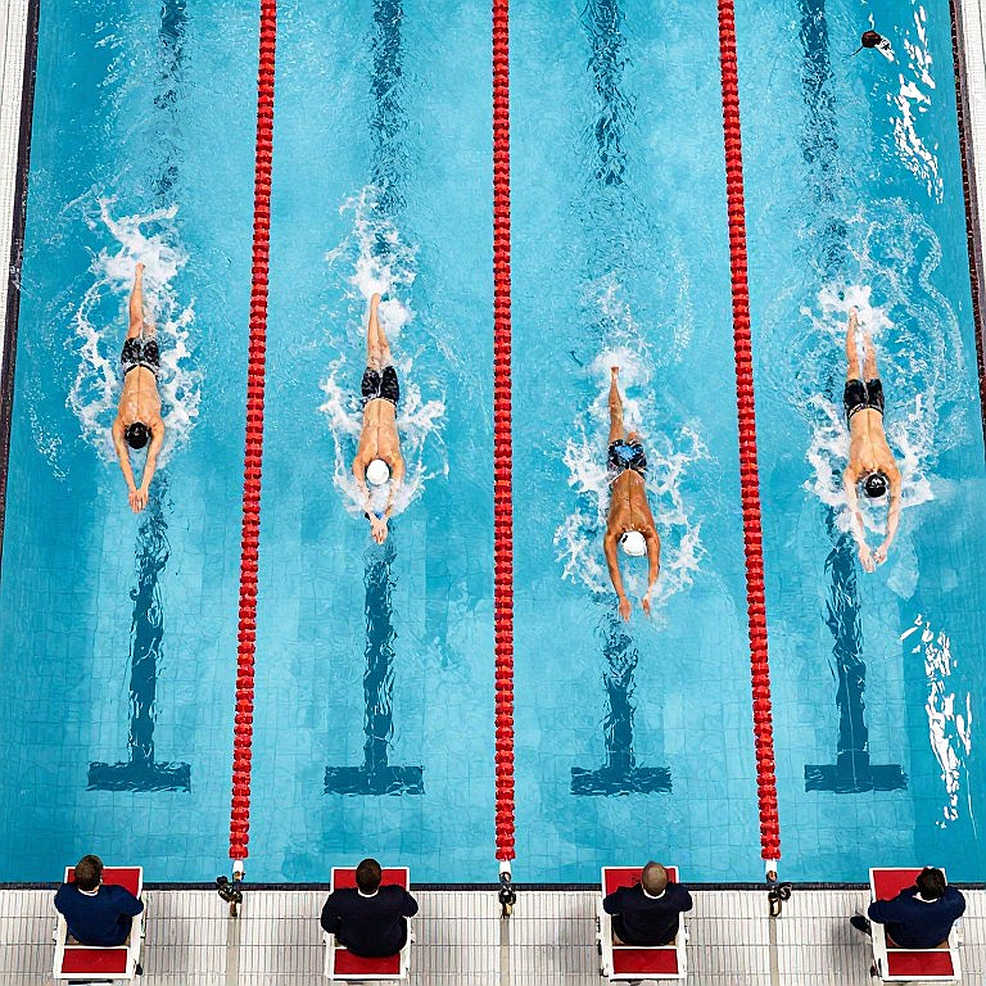
For a data person, the psych sheet is the starting point of everything. It tells you who enters which event, how the seeds are ordered, what the minimum entry times are. Only from there can you build a probability model, compute gaps between swimmers, and estimate final-qualification odds. With no psych sheet, my entire forecasting system sits on hold.
An unpublished psych sheet before the opening is not rare. It reflects that entry lists are still being finalized. But it also creates a specific media gap: while broadcast infrastructure is fully ready, information about the competing subjects does not yet exist. Media runs ahead; data runs behind.

This is where I want to restate a principle that has followed me through my career. Luck is something I do not have. I have probability and data thick enough. But probability only exists when there is a sample. No psych sheet, no sample, no probability. Only belief and gut prediction remain — two things I refuse to use.
I have made mistakes in the past by rushing conclusions on a thin sample. In 2026, when I first explored swimming metrics, I published a regional-event prediction based on just two rounds. The final outcome went fully the other way. Since then I set a fixed statistical-significance threshold for every analysis: no conclusion until the sample is sufficient, and always state the confidence level of each judgment. The missing psych sheet at Nagoya is exactly a test of that threshold.
The contrarian angle: free is not generosity
The common reading of the 700 free hours is: this is good news for fans. North American viewers get a continental Games for free. That view is not wrong, but it ignores the motive behind it.
When a product is streamed free across more than fifteen platforms, that is not an act of generosity. It is a pricing decision. The distributor concludes that the value of attention exceeds the value of subscription fees. It accepts no direct revenue in exchange for something else: viewer data, position in future rights negotiations, and the ability to sell advertising by demographic.
Notably, swimming is not a top advertising sport in North America outside Olympic cycles. Streaming an entire Asian Games free shows the distributor is looking at a loyal but small audience. It is not chasing mass viewers. It is serving a specific demographic — the Asian diaspora community and those who follow continental sport at depth.
In other words, the freedom here is not a sign of high value but of reach optimization for a niche market. This is what I often say when analyzing sports markets: a free rights deal usually reveals the true audience size more accurately than an expensive paid one.
I have seen this model many places. When a small league finds no paid-rights buyer, it switches to free broadcast to at least maintain presence. When a large league, broadcasters compete to pay for exclusivity. Asian swimming's North American position sits in the first group: present, but not paid to be present. For Vietnamese viewers this has no direct effect, but it reveals a truth about the power structure of the international sports media industry we should remember.
One more contrarian point sits in the source brief itself. It devotes a line to saying viewers in other countries may find other options, some available via VPN. This is a procedural sentence, but it concedes a reality: territorial rights boundaries are a line viewers can slip past. The publisher knows this and accepts it as a feature of the modern broadcast environment, not a threat to be thoroughly blocked.
Industry ripple: a shift toward open infrastructure
More broadly, the temporary-channel model Willow TV uses is a signal of where sports media is heading. Instead of building fixed infrastructure and carrying long-term costs, distributors are shifting to short-life online channels tied to individual events. This lowers barriers to entry, letting more niche events reach a global audience, but it also fragments the viewer experience.
This fragmentation has concrete consequences. When content is split across more than fifteen platforms, viewers must actively search for where it plays. There is no single aggregator page. This is why specialist outlets like SwimSwam exist and grow: they serve as a centralized access point in a dispersed environment.
In equipment and infrastructure, this model is neutral. The brief mentions no swimming equipment brand, no suit technology, no equipment-rule change. There is no signal for the coaching market or facilities. At the Asian Games level, staging swimming in a new long-course pool in Japan is infrastructure work completed years in advance and generates no new wave.
What I want to stress to Vietnamese readers is an indirect consequence: the temporary-channel, low-cost, free-to-air model is a template applicable to Southeast Asian regional events. When a regional Games cannot attract a premium rights sale, this model opens the possibility of bringing the event to distant viewers at near-zero cost. That is an opportunity, not just an observation.
What to watch next
The psych sheet will appear. When it does, the forecasting picture closes: only then do we know who competes, who is seeded, and how wide the time gap is between top swimmers. At that point probability models have ground to stand on. Before that, any medal forecast is just storytelling.
What needs watching is not the channel list but the session structure. Morning prelims and evening finals will reveal which swimmer conserves and which empties the tank in the heats — an early sign of individual strategy. And for Vietnamese viewers, the two-hour gap against Nagoya is a rare advantage: we can watch nearly the whole schedule live without staying up late or waking early.
A championship lineup is not found in a pocketbook, but in how time is compressed into a metric. I will wait for the psych sheet. And I will read it with the same certainty threshold as always — because a model only has value when its builder knows when to stay silent.